 I’ll strategize it, architect it, and design it. I’ll help market it. I’ll direct the team that’s assembling it. I’ll even tweak the engine and apply the paint job if we’re short on staff. But if doing all this also makes me responsible for changing its oil every three thousand miles and providing roadside assistance when it has a flat tire, then suddenly I stop being good at my job.
Websites are like cars. I’ve used the metaphor and I’ve heard it from others as well. Even the prices are comparable — do you want a $500 clunker? Something that’s either reliable or sexy (but probably not both) for $5000? Or are you putting down 25 grand for your new baby?
We’ve got website mass-manufacturers. Website mom-and-pop mechanics. Website fuel (hosting?). We sell services that make your website stand out in a crowd. We even give them vanity plates with the special character “.com” on them, and hand out free bling for your sidebars. Let’s keep going with this.
Where are the Jiffy Lubes? Where are the reliable, bonded, high-profile, maintenance shops that you can feel confident handing your hosting passwords to every six months or so for a good, honest, and slightly-overpriced assessment of how things look under the hood? They should be able to upgrade things like WordPress, edit that homepage content you only care to change every once in awhile, advise you about any larger issues, apply some Spam Guard, and send you on your way before dinnertime.
And while we’re at it, where are the website loans for new businesses? And where is the website insurance against hacking, hosting failure, and freeway Digg collisions? How can you upgrade the sound system that is your website copy? Where can you get all that bird shit washed off your outside user-generated content surface? Where can you have your server space vacuumed? How are you supposed to know when it’s time to get your timing belt replaced? Where are you supposed to go to do that? And how can we hold mechanics reliable for doing what we ask without ripping us off? (I suppose that last problem still hasn’t been solved with cars, so maybe I’m asking too much.)
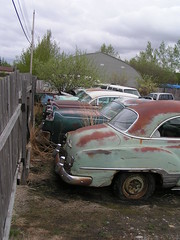 I hate watching people’s transmissions die after driving 100,000 miles without a tuneup. And I’m even less fond of being handed that panicked problem while I’m right in the middle of designing a beautiful new car. But I don’t blame them for it — they don’t have much of a choice. The resources aren’t out there on the side of the road, reminding them to come in for a checkup. Where’s the freaking Jiffy Lube?
If it’s getting to the point where “married couple” is just another way of saying, “two-website household,” it’s time to scale the industry to address the needs of consumers. Too many people assume that whoever built a website is going to be responsible for it forever — even if there’s no maintenance retainer plan in the contract. And true, we — as web developers — created that assumption because we wanted to hold on to our clients. But how many unloved, unmaintained websites are out there now, rusting and creating an eye sore on someone’s front yard because “maintenance” was an assumption instead of a plan? Drop your pride and get real for a second. You’re not happy about it but you don’t want to do the work to fix the situation, do you.
I no longer work on projects where the “designer” and the “programmer” are the same person. I find that — even if someone can do both — their work will be much better if they only have to do one. Having two separate bodies engaged in that arm-wrestling match makes for a better website. And a less crazy team. Even though I used to try to do both of them myself.
I’m adding maintenance to the pile now. I don’t think the manufacturers should be the maintainers. I think it’s a conflict of interest, a disservice to the consumer, and a white lie that’s tainted with an extra layer of fear and pride.
It’s time for the Jiffy Lubes to start popping up on the suburban street corners of the Internet. We’re ready now. And please, do it well.
photo credits: “jiffy lube” by joe dunckley and “rusty car storage” by dave_7 — thanks, guys!
 Posted in Sarah's Soapbox, Technology, Webmaster Stuff |
  3 Comments » | June 23rd, 2008

