Heads up, this content is 18 years old. Please keep its age in mind while reading.

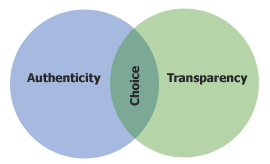
Last weekend I twittered, “I wanna see a Venn Diagram that shows the differences and overlaps between ‘Authenticity’ and ‘Transparency’.”

The thought immediately attracted conflicting (yet brilliant) definitions of the terms.

“‘authenticity’ is about relevance, ‘transparency’ is about defensiveness. the overlap is accidental and uncorrelated.”
— Jenka Gurfinkel, social-creature

“authenticity = what is alive in me, transparency = a conscious choice to disclose that b/c I want to live in that kind of world.”
— Emma McCreary, joy ninja

Understandably confused, I started asking around for more thoughts on the matter. Here are some of the responses that came in…

“I don’t think authenticity means anything more than what is real and true. And I agree that transparency is about how much of what is authentic you choose to give those outside the window in to see. No one said it had to be 100%, by the way. You have choice. That choice is the overlap.”
– Elisa Camahort Page, Worker Bees Blog

Aha! The Venn Diagram!
doppjuice_auth_trans_choice.gif

Beth Kanter continued the conversation over at BlogHer and her own blog, relating the concepts to the nonprofit sector and pulling in some great comments. She also dug up the wikipedia definitions:

  • Authenticity refers to the truthfulness of origins, attributions, commitments, sincerity, devotion, and intentions.
  • Tranparency means open, frank or candid.

Mark Resch took the business angle: “authentic means authored by who you think made the thing in question. transparent means that the author made it so that you (or anyone) can see how the relevant parts work—especially the important inputs and outputs.

Meanwhile, another tech industry thinker (who in a completely relevant way asked to remain anonymous) said, “Not being 100% open about everything I know in my professional technical field actually makes me trusted. If people know they can go to you and share information that is yet to be made public and know you are not going to share…. well this makes you trusted. So ‘radical’ transparency is actually not ‘good’ for building trust and relationships. Authenticity is more about how you are sharing and is it ‘true’ and real for you in relationship to others.”

My friend Koan added some pithy thoughts to the pile: “Authentic is what I say about who and what I am – transparent is being open about why I’m saying it. Authenticity is walking the talk – transparency is talking the walk.”

And then Emma threw in another quick summary: “Authenticity is a need — transparency is a strategy. Thus transparency can meet a lot of different needs for different people, authenticity is just one of them.”

George Kelly of allaboutgeorge went for the meat of the definition. “Transparency is an internal choice projected externally, how one acts based on how one desires to live. It’s demonstrated and performed by one person or entity for an other (or others). Authenticity is a valuation, a label, about one’s essential nature, from the outside-in. It accrues to a person or entity and is attached by others (or an other).”

Amy Gahran of Contentious.com put it all into straightforward terms: “I think of “transparency” mainly in terms of disclosure — opening up your process of creation or exploration to examination — not simply selectively displaying the finished, polished product. I think of “authenticity” in terms of being honest (true to yourself and others) about who you are, the role you’re playing in a given context, and your values and identity. This is more of an internal mindset that influences what you end up creating, saying, or doing online or in the real world — whereas transparency is more of an external practice.”

But what about where the green part of the diagram? Whitney Moses tackled that one: “If your true self is very private, then over sharing wouldn’t be very authentic, but it could be transparent. Everyone can tell they’re inauthentic when they’re trying to put up a good front.”

Finally, Melinda Klayman boiled it down to the point: “Authenticity is about meaning what you say. Transparency is about saying what you mean.”

Thank you all for your brilliant thoughts.  I think I get it now.

Heads up, this content is 18 years old. Please keep its age in mind while reading.

I headed out to the Paul McCarthy exhibit opening tonight with co-conspirator Melinda Klayman. While trying to navigate the heavy crowds, we ended up stuck in between two men who were wearing strange sashes.

To make conversation, Melinda asked if the sashes meant they were in a cult. They smirked and looked at each other for confirmation, and then nodded in agreement.

“Well, then, which one of you is the leader?” I asked.

They looked at each other again, and the tallest one said, “The last one standing.

The shorter one slapped him on the back, laughing, and said, “I can’t believe you still remember that! That’s right! That’s how you choose a leader!”

Melinda and I looked confused, and the tallest one explained. “The way to pick a leader is to have everyone in the group stand in a circle. Eventually, people will start sitting down. The last one still standing is the leader.

I visualized a group of determined men standing in a circle for 12 hours on end, hungry and thirsty and wriggling their fatigued legs to keep the blood flowing. I realized they probably had to urinate into the center of the circle, too, and I hoped this was happening in the middle of the woods somewhere. “How long does it usually last?” I asked.

“Oh, about five minutes,” the taller one said.

The shorter one saw the look on my face and explained. “If we’re all standing in a circle, I’m going to make eye contact with you, and with you, and with you, and I’m going to think to myself, ‘Well, I’m not the leader here,’ and I’m going to sit down.”

“What if not everyone sits down?” I asked.

“I don’t know. That’s never happened,” said the shorter one.

The taller one chimed in excitedly. “No! It’s happened! Then there’s the second round! See, we put a time limit on the circle. Say, five minutes. If, at the end of five minutes, two people are still standing, well then they’re both out, and we start the circle over again without them.”

The shorter one nodded sagely. “Right… because if they’re unwilling to capitulate, then we don’t want them as our leader.”

The taller one added, “One time we had to do three or four rounds of this.”

Melinda and I sat back and took this all in. “So how well do these leaders usually work out?” she asked.

“Very well,” both of them men said. “We’ve never had any problems.

Heads up, this content is 18 years old. Please keep its age in mind while reading.

Some people rely entirely on prayer. I find that prayer yields better results when I augment it with social media. Here was my recent cry to the Universe (made through a friends-only social networking website):

“I need to buy a car right now and I don’t know where to start. I haven’t owned a car in three years! I want something reliable that will run forever and gets good gas mileage. I don’t want to spend a lot and I’ve never bought a car without help before. Um… crap!”

The suggestions started rolling in. Honda Civic. Toyota Corolla. Vehix.com. Cars.com. Carfax.com. Kelly Blue Book. Names of trusted mechanics. Tips on finding the right insurance agency. Info about smog checks and DVM registrations. Reminders that rush hour traffic is sometimes slower than Caltrain. Reminders that I don’t have to do anything without help, ever, if I don’t want to.

This sent me in the right direction for research, and I quickly narrowed down my focus to exactly what I wanted: a 2000-2004 manual transmission 4-door Toyota Corolla with power locks/windows and in a dark color, somewhere local. Excellent. That was easy.

But then I scoured the listings and couldn’t find one. Well, that’s not true — I did find one, but it was at a really sketchy-looking small used car dealership with a disturbingly bad website. The car went crashing off my radar when I saw the dealer’s horrible “About Us” photo. Um, no.

fred.jpg
[This photo is a direct lift from the website. I did not reduce its quality for dramatic effect.]

I went back to my social networks to tell them my tale of woe, and they agreed that the man behind the desk was not to be trusted. Peanut gallery quotes included: “where’s his computer? this is well into the 21st century; every work desk should have a computer at it,” and “The picture looks like he’s finalizing plans to take over the world… from his computer-less desk. Haha! ‘You’re right, Skeletor, it will be as easy as taking candy from a baby! Mu-hahahaaaa!’

Meanwhile, I was decompressing on Twitter, feeling discouraged about the process and getting a lil’ bit silly in my musings. The twitterpaters cheered me up with hedonistic influence and emotional support. I remembered that I was shopping with an army behind me. They had my back.

And then, something magical happened. A friend who had been watching my prayers sent me a link to My Dream Car, being auctioned on eBay Motors from a dealership just south of San Jose. The “Buy Now” price was exactly my budget and exactly the value on Kelly Blue Book. I tried to brush it off as “too far away,” but then another friend offered to drive me there.

car.jpg

Frantically, I asked the Universe for tips on buying from dealers, and it filled my head with suggestions. Then I researched the vehicle history report on Carfax (completely clean) and looked up everything I could find out about the dealership. 400 people on eBay told me they were wonderful to do business with. That’s social media shopping for ya.

I showed up and walked straight to the car. The receptionist quickly tossed me the keys and let me take it for a test drive. It was just as delicious as I hoped it would be. The saleswoman showed up and asked how I was doing. I said, “I like this car. Can I buy it from you?”

She smiled and said, “Yes.”