Heads up, this content is 18 years old. Please keep its age in mind while reading.

Last night the newly-freewheeling Susan Mernit and I attended the SD Forums meeting on Using the Social Graph / Social Platforms to Enhance Search at the Yahoo campus. The panel included representatives from Yahoo, Google, Facebook, and Chirp, and they grappled with questions about what the Internet is going to do with all of this information about who is connected with whom. Here are a few of my takeaway notes:

  • When we search, we find things we were looking for. When we participate in social networks, we find things we didn’t know we were looking for.
  • To subscribe to someone on Twitter is to use them as a media source.
  • Our public content and our public statements about our social graph are a kind of performance. (Dopp Juice is a kind of performance.) This stuff needs to be treated differently than private conversations (messages, emails, IMs), which are meant to be off-stage.
  • One-way connections (e.g., following someone on twitter) articulates what you’re interested in. Two-way connections (e.g., an email conversation) articulates who you’re interested in.
  • Direct search has been nicely monetizable (see Google’s Massive Empire) because it involves a direct interest, but social search is the new frontier for monetization.
  • Social networks SHOULD NOT ASK PEOPLE FOR THEIR GMAIL AND YAHOO MAIL LOGIN INFO. (i know, we’ve talked about this already, but it was nice to hear it on the panel from the Yahoo rep, too.) His reasons: our email address books include everyone we’ve ever emailed; not just the people we have valuable relationships with. The tactic is spam-producing and relationship-damaging.
  • Facebook’s style of social networking sometimes creates lightweight friendships that obfuscate the value of networks. Knowing who my 20 best friends are is often more valuable than knowing who my 500 best friends are.
  • There is an ongoing tension between privacy and portability. How do we keep our information safe, versus how do we carry our information with us?
  • True portability involves both the ability to extract your information in a way that can be used elsewhere and the ability to delete it from the system so that it’s no longer in the first network’s hands.
  • There can never ever be a privacy surprise. If the user sees you publicly displaying something that they thought was private, you just lost their trust in a very big way.
  • There’s user-generated content and then there’s information about the user’s social graph. These are separate things. To do cool things for fun and profit on this next frontier of social media, you’re gonna want access to both.
Heads up, this content is 18 years old. Please keep its age in mind while reading.

There’s a lot of buzz right know around something called the social graph. This buzz is very geeky, and if you’re not already immersed in geeky conversations about Internet privacy and identity, this buzz might be going over your head. That’s a shame, though, because you probably do care about it.

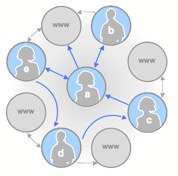
socialgraphapi.jpgWhat’s a Social Graph?

You have lots of contacts. Some are professional colleagues, some are personal friends, some are both of those, and some are more complicated than that. A social graph is a snapshot of who you’re connected to and how. The specifics are super-geeky, so I’m not gonna go any deeper than that.

What’s Happening Now?

Google just released something called the Social Graph API. This is going to make it easier for social networking websites to share information about who you’re connected to. This opens up a huge can of worms in terms of privacy and identity and security and all that fun stuff that the Internet’s been debating since it was born.

How Does This Affect You?

At the moment, it doesn’t. It’s too new. But it’s pushing the borders on what we need to think about when we use social networking websites, and that’s going to matter to you as soon as it gets to your favorite websites. Looking ahead to the not-so-distant future, you should probably prepare yourself for two things:

1) You’re going to have an easier time sharing your “friends list” between your social networking websites without having to give out your email address book. This also means that signing up for a new social networking website won’t be such a headache.

2) You’re going to have a harder time compartmentalizing and obscuring different parts of your life on the Internet. There will still be a place for pseudonym-based anonymity, but with all of these networks talking to each other, it’s going to be harder to hide. So if you’ve got skeletons in your public MySpace closet and you’ve just figured that nobody’s gonna look behind that door, you might wanna go clear those out now.

Heads up, this content is 18 years old. Please keep its age in mind while reading.

heath_ledger.jpgIf this is the first time you’ve heard the sad news, I’m very sorry to break it to you. Heath Ledger died.

But if you’re under the age of 35 and are friends with people who connect with each other on the Internet, I’m guessing you knew within five hours of it happening. And when you did, you might have felt a surge of responsibility to let other people know about this handsome young actor’s unexpected death, because wow, that’s crazy, and since Heath Ledger isn’t usually in the spotlight, maybe your friends didn’t hear about it as fast as you did.

And then you probably sat back and watched the rest of the world notice it, too. Maybe you got text messages about it. It probably showed up in your RSS feed reader multiple times. Maybe you went out to get coffee, and ran into a friend at Starbucks, and the first thing out of their mouth was, “Dude, did you hear Heath Ledger died?” Conversations you overheard on the street turned into games of speculation: Closet drug addict. Being famous is a huge amount of pressure. Did a woman break his heart?

I was shaken out of the stupor when a friend of mine stepped up and called bullshit:

Seems like everyone I’ve spoken with, since ~2 pm this afternoon, has felt compelled to mention – within a couple minutes of saying hello – that Heath Ledger is dead. Likewise for the blogsphere, Twitter tweets, SMS flurries, email one-liners, … etc. I don’t want to seem crass or unsympathetic, and I actually fear coming across as such… But… WTF? … Why this buzz around Ledger among the twentysomethings passing through my day? No one seemed to notice that the bizarre chess genius Bobby Fischer is dead, for instance…

NPR’s On the Media took a stab at the question on Sunday, from a press perspective. Noting that with the advent of social media, the rumor mills turn faster than the printing presses these days, the public demand for immediate information is fierce when its interest is piqued. The Associated Press recently started writing pre-emptive obituaries for notoriously self-destructive celebrities like Britney Spears and Amy Winehouse, just so they’d be prepared for the widespread information feeding frenzy if the news of sudden death ever broke.

But Heath Ledger? Heath Ledger wasn’t on their radar for an early death. Heath Ledger caught the press completely off-guard, and so the breaking news was handled by the masses.

And as one of the masses, I raise my glass. We’ll remember  you, Heath.

Your Biographies:

Your Films: